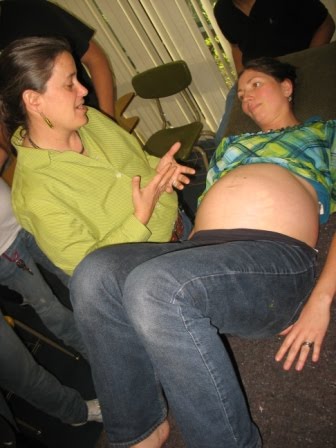
As soon as I was pregnant with our first child in 2007, I knew I wanted to deliver at home. However, my desire was driven by fear of the hospital rather than love of home birth. To be clear, I am not generally afraid of hospitals or medical procedures, but harbor a strong belief that obstetric care in the US is wildly misguided. I had amassed a binder full of articles pulled from PubMed, read and hi-lighted, and was thoroughly convinced that I was making this decision based on fact and reason, not passion. The thought of checking myself into a L&D ward during a perfectly normal labor brought me to tears, with visions of well-intentioned routine precautions derailing my labor. To be sure, it was a months-long struggle gaining the support of my husband. He was convinced that the articles published to date were not statistically significant, and did not understand how a woman's confidence in herself and her environment could affect the odds of success. Finally, after seeing The Business of Being Born (and me in tears yet again), my husband acquiesced. A short documentary did for me what months of debate based on published medical literature could not. God bless Rikki Lake.
Coming into the BAHC community from this self-described rational perspective, there were many aspects of the midwife style of care which we found strange and confusing. To start, my husband and I hardly knew what to do with our hour-long prenatal care visits with Maria. We would talk about this afterwards, wondering why we had to set aside so much time out of our busy schedules (let alone Maria's) for these appointments, which sometimes seemed to have more silent pauses than agenda items. I found it odd that Maria would palpate my abdomen and talk to me about the indicators of where the baby was; no OB had ever really touched anything except my vagina or breasts. I listened with some skepticism as Maria coached me through how to protect and nurture my belly and the baby through the second and third trimester, and postures which could encourage the baby to turn to a favorable position. By contrast, nothing of this sort was addressed by the OB providers whom I was seeing for concurrent care. Anand and I both rolled our eyes walking into Scarlet Sage to buy herbal supplements at 36 weeks, until I felt the wonderful practice contractions brought on by whatever tincture Maria had recommended. Because we were blessed with an uneventful pregnancy, we had no need to test the limits of Maria's knowledge further; in retrospect, I know we would not have been disappointed.
Compared to other birth stories shared here, Rohan's birth was somewhat mundane. But to me, this average textbook birth was beautiful and perfect. We cherish every memory of that day, frequently reminisce together, and are eager to regale any willing friends with the story. The hi-lights of that 19-hour process include: the rush of adrenaline and excitement when the waters broke, a few hours of restless sleep before active labor, a beautiful sunny walk through the neighborhood, squeezing my husband's hand so that he could time contractions for me, deciding together when it was "real" enough to call Maria, my husband leading me around our bedroom so that I could walk slowly with my eyes closed, glimpsing St. Lukes in the distance and feeling reassured that backup is available but so grateful we didn't need it, the blissful relief of a long hot shower, eating plain noodles to rejuvenate and later throwing them up violently, feeling so humble and vulnerable and grateful for my husband's calm and acceptance as he held my hair, sleeping so deeply in between contractions, finally reaching a point where the only way to channel the energy was to squeeze my partner's hand, looking up from one of these contractions wiping sweaty hair from my face and seeing Maria's face as a constant presence.... finally choosing where and how to birth our son, the joy of hearing him scream when he was born and knowing that he is healthy, seeing my husband's tears of joy, hearing him say our son's name: Rohan.
We invited both of our mothers to come meet their grandson as he was still attached to me, and our naked, bloody sticky selves were cuddling and crying and smiling; I will never forget the look of wonder and joy on their faces. Later, the feelings of gratitude continued as Maria and Sue helped with the afterbirth, cleaned me, helped me to the shower and bathroom, and showed me how to begin the healing and bonding process. The night concluded with a family dinner downstairs, a birthday celebration with cake and champagne, and my husband and I going to sleep in our own bed in awe at the beautiful baby by our side. For months, I had rapturous vivid flashbacks of birthing our son.
We grew into parenthood, Rohan grew into a toddler, and we decided that he was so wonderful we should give him a sibling. This time, the first words my husband said regarding the pregnancy was: "let's make sure to call the midwives right away before they're booked." What a difference a birth makes! We were thrilled at the idea of planning another home birth, but had to reconsider this decision a few weeks later when an ultrasound confirmed we would be having twins.
Since 2007, there had been even more articles published regarding the safety of home birth, but still no data addressing twins. Looking through OB literature as well, there are very few prospective trials to prove the necessity or benefit of typical OB management of twins. The only common theme shared between OB and midwife literature is that twin births involve more risk. If I were to fight for home birth again, it would be a decision based purely on philosophy and faith. In contrast to my first uncomplicated pregnancy, I knew I could not defend my choice if a tragedy occurred delivering twins at home. Fortunately, thanks to the experience afforded by Maria and Sue, we felt stronger and more confident about navigating the hospital experience for our second delivery.
However, we noticed immediately upon starting our prenatal care that there were now many aspects of the OB style of care which we found strange and confusing. We missed those hour-long appointments! Because I was carrying twins, I was allotted a whole 20 minutes to see my provider, rather than the standard 10. We had so many questions about twins and hospital births - even with a meticulously prepared written list, there wasn't time to get clear answers on what to expect. I was asked to plan on having an epidural, so that I would be made more compliant in case of an internal version or breech extraction of twin B. I was told that even a vaginal delivery would take place in the OR, "just in case." I was told that labor should be induced if I went past 38 weeks gestation. Nearly continuous electronic fetal monitoring was planned, and it wasn't clear whether the equipment would be wireless to allow movement. Our contact with the OB was limited to efficient question-answer dialog, planning the next appointments, and doing the routine physical exams. Other than the rigid kick counts and braxton-hicks recording I was supposed to be doing twice a day, there was no energy spent encouraging me to communicate with the lives growing inside me. Adding to our anxiety was the uncertainty regarding how many support people (zero, one or two?) would be allowed in the OR for delivery; it all depended on the hospital staff on duty when I presented in labor.
Fortunately, Maria and Sue had awakened and nurtured in me an innate trust of my body and my babies. In this pregnancy, I KNEW my babies from the first trimester, and I knew they needed me to take it easy in this pregnancy. I nourished our bodies, rested, and tried to stay calm. I did my own research regarding the recommended interventions, and came to have confidence in my decision to NOT induce labor if I went past 38 weeks, and not to have an epidural "just in case." I bonded with my babies, and grew to understand which was more mellow and which more feisty, which one might have more trouble keeping food down, which one was likely to emerge first, and what position they wanted to be in. Noah (the mellow one) was breech until about 32 weeks. I sensed he was ready to turn, engaged some of the postures Maria had suggested, and he turned vertex less than 48 hours later. I knew waking up in the morning that he was now in his birthing position, though it took my OB, NST nurses and radiology techs several more weeks to believe me. Although the radiologists couldn't tell which baby would be delivered first, I sensed that Shaan would probably edge his way past Noah; he proved me right at our last ultrasound one day before their birth.
We made it just past 36 weeks when Shaan's water broke around 1:30 AM. I still harbored some anxiety about having to defend my birth plan, and was afraid of the fetal monitoring. Although I thought it would be best to tackle these hurdles before labor became too intense, I started to procrastinate. My husband and I spent some time deciding who to call and in what order, we had a final fun debate about naming the twins, we did email and Facebook. I slowly packed my backpack with a million battery powered devices for labor music and ignored my contractions. My parents arrived, and watched while I finished a bowl of cereal and meticulously peeled and ate an orange. We left home at 4 AM for the short drive. In the car, we noticed contractions were about 2-3 minutes apart, but I rationalized that was due to potholes. We breezed into L&D as a family, husband, mom and dad; I told the triage nurse my pain was a "4" (laughing to myself, 'whatever that means') and settled in with my iPod and three straps on my abdomen. She took her time trying to get the prescribed amount of fetal heart rate tracings, which took over an hour. Curtains were drawn around me as the nurse worked to admit another woman who was much more vocal in her labor than I. Meanwhile, labor was feeling more intense, but I continued to rationalize: maybe I was having trouble catching the endorphin wave because of the hospital environment? Surely the straps on my abdomen are making it more painful? Labor couldn't possibly be finishing this quickly, right? In any case, I had disappeared to that magical place within myself, and did not have the energy or will to express these thoughts to strangers.
When I was officially admitted over an hour after arrival, I was asked if I wanted to walk to the labor room or go by wheelchair. Naturally, I walked. With a chucks pad awkwardly held between my legs, three straps on my abdomen, a ridiculous hospital gown, two blankets shrouding my naked backside and three cables looped over my shoulders, I made the short journey in a daze, indulging in some feelings of martyrdom. No one had yet checked my cervix, and the triage nurse had no clue that delivery was imminent; she settled us into the room and left us, promising the doctor would be in soon. Within moments, that familiar involuntary spasm took hold, and Shaan started his descent. Because I was still standing over linoleum, my mom got in position to catch him, and my husband started hitting the red panic button and calling for a doctor. The attending OB arrived as Shaan was crowning; Shaan eased into the world with one more contraction, immediately pink and vigorous. Only a little over four hours had passed since his water had spilled forth. The pediatric team wasn't there yet, so I got several minutes to kiss his sticky head and cuddle him while the doctors worked around his cord to check Noah's position and heartbeat.

Waiting for NoahThe attending doctor that evening - whom I was prepared to encounter as an adversary - turned out to be magnificent. She sized up my personality and the situation within moments, and orchestrated the atmosphere and pace of the remaining delivery beautifully. Someone mentioned if we should still move to the OR for delivery of the second baby, but she saw my face and quickly abandoned the standard protocol. No one breathed a word about epidural or IV access. This was lucky, because things really slowed down, and I'm not everyone would have had the patience or confidence to wait for Noah's birth if I were in an OR. Either due to a half-empty uterus, the joy of holding Shaan, or 8-10 strangers staring at me expectantly, I stopped having regular or meaningful contractions. Noah was still in cephalic presentation, his heartbeat was strong, and I wasn't bleeding heavily, but labor was arrested. The OB was very reassuring, but refused to leave my side - she mandated quiet calm focus. Though she didn't mention it, we all knew there was a small chance of catastrophic placental abruption or cord prolapse for Noah, whose water bag was still intact. I tried standing, moving my hips, closing my eyes, willing contractions to come, alternately relaxing and pushing, for over an hour. Pushing without the urge is somewhat like trying to sneeze at will: it's never quite as effective. Finally, the OB gently offered to do an exam to determine if it may be safe to artificially rupture Noah's bag of waters. By this time, I was quite ready to meet my third child, and gratefully accepted. Once Noah's head was better engaged, my awkward forced pushing was much more effective, and he was born about 90 minutes after Shaan. Turns out Noah had the umbilical cord tightly wound twice around his right foot - the length of cord remaining for delivery was short, which may have slowed his birth. Noah came to us in three big chunks rather than one whoosh. He was placed on my chest immediately, and I only noticed later in the pictures that his cord had been clamped against my wishes -- one small sacrifice for an otherwise perfect birth.
The attending OB asked me not to share her name, lest other women come clamoring for the OB who is supportive of an epidural-free, OR-free natural vaginal delivery of twins. But it is possible, and it was wonderful. In fact, all the doctors involved later confessed that they felt lucky to be working when my "precipitous" delivery (never mind the hour-long wait in triage) voided all protocol, so that they could witness and learn from a natural birth. Our story was shared among the staff, and we later heard from doctors on shift before and after that they were disappointed that they missed out. Perhaps most OBs in their hearts actually want to practice natural hands-on medicine, but feel bound by institutional practices and professional guidelines designed to defend against litigation. Maybe we should look into their eyes to see what they really believe when they tell us that an intervention is "recommended."
My husband and I spoke about this afterwards. The big bad hospital turned out to be full of well-meaning people who were consistently kind. The shift changes were actually nice, because each new nurse brought with her a new perspective or tip for breastfeeding or recovery. At times their insistence on frequent feedings and vital sign checks on our sleepy newborns could have undermined our confidence, but we were basking in happiness at having two healthy babies, and trusted from our first delivery that all would be well. Having twins, we were grateful for some of the efficiencies of the hospital, getting the birth certificates, social security cards, hearing screen, newborn screen, etc all done in one location. But we left exhausted from all the hospital activity, and feeling that we shared this experience more with strangers than each other. The magic of home birth was lost, and there have been no euphoric flashbacks for me. We are happy that we made the right decision for our family, grateful that we entered the hospital armed with the calm confidence instilled by our midwives, and thrilled with the outcome. But there is no place like home.

 Josephine from Rwanda on the left
 Sara from Uganda and Josephine from Rwanda